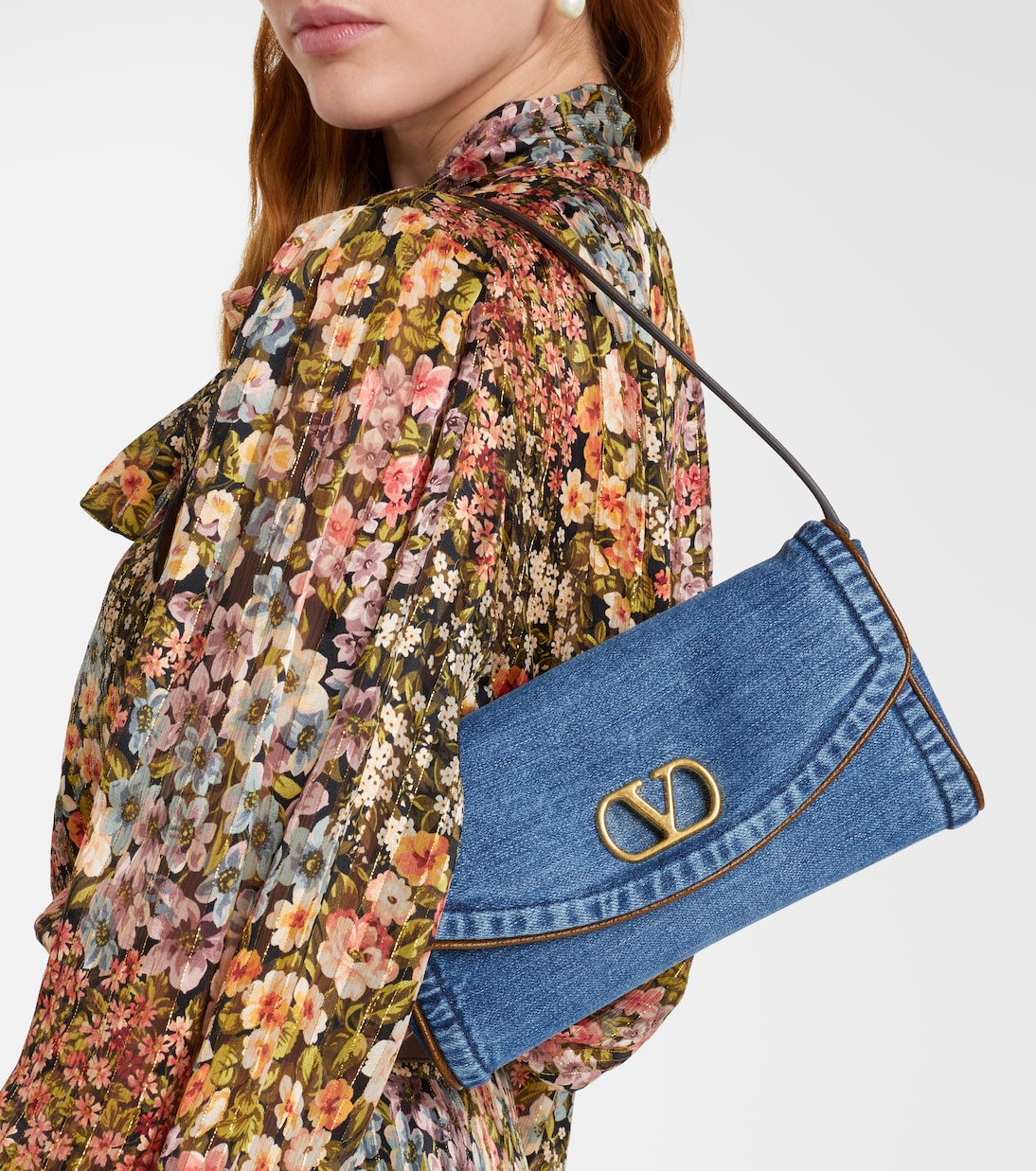
Valentino Crossbody Bags: The Full Guide
Ask someone unacquainted with the house to picture a Valentino bag and what appears is something compact worn across the body, the strap drawing a diagonal over a coat. That instinct is accurate about how people wear the house and wrong about how the house organises itself. Bags from Valentino Garavani function superbly as crossbodies; the house simply never opts to use the word as a category. This overview maps the group the way buyers actually meet it: which pieces genuinely do the job, what each one costs at observed 2026 market prices, and where a crossbody sits against the rest of the range. The numbers here are prices observed in the market over the course of 2026 research, not entries from an official price list, and they move constantly. The aim is a working map before you shop, not a receipt.
The category everyone has except the brand itself
Here is the quiet oddity behind almost every valentino crossbody bag search: the brand’s own US site has no crossbody category page at all. Its bag navigation is built from Shoulder Bags, Totes, Top Handle Bags, Clutches, Wallets and Small Leather Goods, and the crossbody idea lives inside those buckets as a descriptor rather than a door you can walk through. The major multi-brand retailers follow the opposite approach and maintain real crossbody pages — hence a search that finishes on a department store’s filtered grid rather than the house’s own shelves. The practical consequence is that browsing officially means opening Shoulder Bags and Small Leather Goods and reading each product on its own terms. It also means the category is assembled by shoppers and stockists rather than handed down, so its edges are genuinely fuzzy. The three pieces below are the solid core rather than an valentino mini chain bag exhaustive list.
Rockstud small crossbody: the anchor of the group
One bag carries the group, and it is the Rockstud small crossbody, observed in 2026 between $1,650 and $1,950 in grainy calfskin, the laminated calfskin version at $1,790. Nothing arbitrary about that spread — within one model, material and finish determine the price far more than size does, which is how two bags of almost identical proportions land hundreds of dollars apart. Credit the Rockstud motif for the fact that the piece reads as Valentino from across a room — pyramid studs introduced in Fall 2010 by then co-creative directors Maria Grazia Chiuri and Pierpaolo Piccioli, first on footwear, and inspired by the rusticated stonework of Roman architecture. It remains the most legible signature the house owns, and Rockstud is its deepest current line at roughly fifty-two live pieces. As a first valentino garavani bag it is the most defensible choice, identifiable without being fragile and priced in the commercial middle of the range. It is also one of the pieces most likely to appear when the house runs an official seasonal sale, which matters if you are holding out for a valentino bag sale rather than buying on impulse.
Rockstud Spike crossbody clutch: one step up
The Rockstud Spike crossbody clutch sits one rung higher at an observed $2,400, and the brief it answers is a different one. The wider Spike family is priced from about $2,550 for a small in suede to $3,700 for a medium in embroidered nappa, with kidskin at $2,950, small nappa at $2,800 and medium nappa at $3,500 filling the middle. On that ladder the crossbody clutch is the least expensive Spike available new, so it works as the obvious way in if the line’s hardware appeals but a full-size shoulder bag does not. The shape is the trade-off — a clutch-derived body takes a phone and a card case, which makes it a second bag rather than your only one. Buyers wanting Spike capacity alongside Spike detailing typically ends up in the medium sizes several hundred dollars higher. Material weighs more here than most people expect: suede and embroidered nappa versions of otherwise comparable pieces can sit more than a thousand dollars apart.
Rockstud chain wallet: the least expensive way in
Third comes the Rockstud chain wallet, seen at $1,250 in laminated calfskin — the cheapest way to a crossbody silhouette with the house’s signature hardware on it. Wallet-on-chain designs live in an odd space in luxury — catalogued as small leather goods, worn as bags, priced nearer to accessories. That last point is the appeal, since $1,250 sits several hundred dollars below the small crossbody and lands inside the entry band of the range. Capacity is what you surrender: a chain wallet is a flat card-and-cash object with a strap, rather than a compartmented bag. Preserved in the trade are the studs, the Italian construction and the interior tag that identifies the piece. As a first run of whether wearing valentino bags suits you at all, ahead of spending mid-four figures, it is the sensible experiment.
The three core pieces, at observed 2026 prices
Collected in the table below are the pieces that genuinely function as crossbodies, each with the material its price was observed in. It is a snapshot of the 2026 market rather than an official tariff — the house issues no fixed public price list. The pattern it exposes holds across the whole range, and it is that material drives price more than size does. The band column is there so that each piece’s position in the wider range is plain at a glance. The overall spread is strikingly narrow too, with every one of the three between $1,250 and $2,400. The compression is exactly what makes this the most approachable corner of the line.
| The piece | Material as observed | Price observed in 2026 (USD) | Price band |
|---|---|---|---|
| Rockstud chain wallet | Laminated calfskin | $1,250 | Entry level |
| Rockstud small crossbody | Grainy calfskin | $1,650-1,950 | Mid |
| Rockstud small crossbody | Laminated calfskin | $1,790 | Middle |
| Rockstud Spike crossbody clutch | Not given in the observed listing | $2,400 | Mid |
Where crossbody sits on the wider price ladder
Take the whole bag range and observed 2026 prices sort into three bands; the crossbody group sits over the first two. The entry band runs from about $650 to $1,500 and holds VLogo Signature clutches at $650 to $790, Rockstud wallets at $1,250 and the Rockstud mini shopping tote from $1,390. The middle band, roughly $1,650 to $3,600, is the commercial core and contains most Rockstud, Rockstud Spike, Locò, VSling and VLogo shopping pieces. Above $3,700 the top band is defined by embroidery, crystal and pearl settings and exotic skins, climbing through python at $5,650 and ostrich at $7,600 to an embroidered Panthea at $7,900. No piece that serves as a crossbody reaches the third band, and that is telling: the category is where the house sells utility rather than spectacle. The first two bands are your territory if you want a valentino bag that gets worn weekly rather than admired occasionally.
What to check before you pay
The one check worth making first has nothing to do with stitching. Authorship comes before authenticity, because Valentino S.p.A., the Roman house behind the Valentino Garavani accessories line, and Mario Valentino S.p.A., a leather goods and footwear company founded in Naples in 1952, are separate and unrelated businesses. The luxury house’s bags carry VALENTINO GARAVANI; a bag reading only “Valentino” with “Mario Valentino” inside is a genuine Mario Valentino product from a different company at a different price point. A 1979 coexistence agreement between the two firms is what leaves the double name a contractual obligation. Check the interior tag on a couture-house piece: VALENTINO and GARAVANI in capitals plus MADE IN ITALY, sewn on all four sides, the stamping evenly pressed. Expect a serial number on a tag inside an interior pocket, but not always: it is not universal, older bags may carry none, absence on its own proves nothing, and there is no date-code system here of the sort other houses operate. Buy from the house’s own boutiques and webstore or from named authorised retailers such as Neiman Marcus, Bergdorf Goodman, Saks Fifth Avenue, Nordstrom, Selfridges and Harrods.
The verdict on the category
Valentino’s crossbody offering is tightly drawn, coherent and unusually easy to reason about. Three pieces carry it, and each occupies a clear rung rather than overlapping with its neighbours. Take the missing category page as a navigation quirk and not a hole in the product line. Resale behaviour deserves a footnote: verified marketplace data puts the house average near 41 percent of original price, with hero styles including a Rockstud pouch crossbody landing around 50 percent, so this is mid-tier retention rather than the strongest in luxury. The upshot is to buy what you will actually wear rather than what you hope will appreciate. Apply that test and the crossbody group emerges as the most sensible part of the range.